Discover the best AI image generators of October 2025 — ByteDance leads with Seedream 4.0, while OpenAI’s GPT-5 loses ground.
AI Image Generators: The Top Performers in October 2025
In October 2025, the race for dominance in AI image generation continues — and ByteDance remains firmly ahead of the pack.
Just a month after its official launch on September 9, the company’s latest model, Seedream 4.0, is still topping the Text-to-Image Arena ranking, a live leaderboard that measures model performance based on real-time user votes.
Meanwhile, OpenAI, once a leader in the space, is seeing its models gradually slip down the rankings.
ByteDance Holds the Crown with Seedream 4.0
According to ByteDance, Seedream 4.0 offers advanced multimodal capabilities and can “seamlessly switch from one artistic style to another.”
These improvements have clearly paid off: the model has held first place for the second month in a row, while its predecessor, Seedream 3.0, climbed one spot to fifth position.
Google’s Big Comeback in AI Image Generation
After lagging behind OpenAI, Midjourney, and Black Forest Labs for several years, Google is now making a strong comeback.
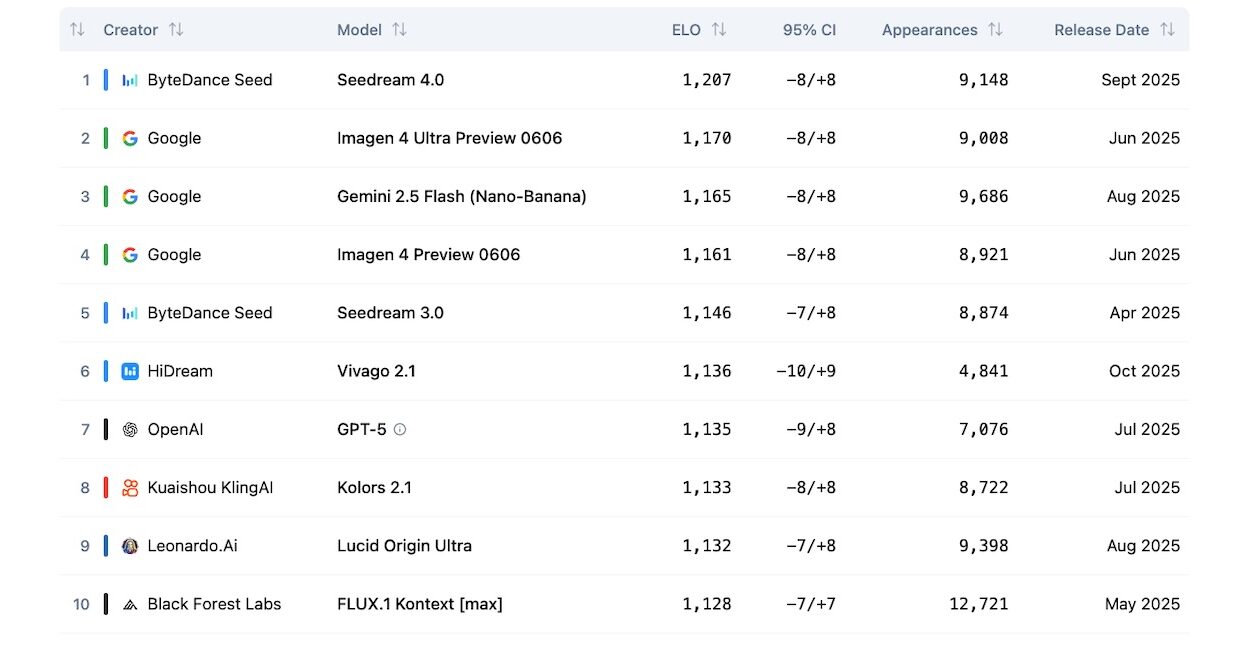
Its latest trio of models — Imagen 4 Ultra, Gemini 2.5 Flash, and Imagen 4 — have all entered the top five, ranking 2nd, 3rd, and 4th, respectively.
This marks a major shift in the competitive landscape, showing that Google’s latest research push in generative AI is finally paying off.
OpenAI Falls Behind
In contrast, OpenAI’s decline continues.
The company’s models have seen little innovation in recent months, and its flagship GPT-5 now sits in 7th place, with a score of 1,135 Elo.
It trails behind ByteDance and Google — and is now just ahead of Kolors 2.1 (Kuaishou Kling AI) and Lucid Origin Fast (Leonardo.AI).
Meanwhile, FLUX.1 Kontext, developed by Black Forest Labs, barely holds onto a spot in the top 10, and Midjourney — once the benchmark for creative generation — has fallen to 30th, while Reve stands at 18th.
The Top 10 AI Image Generators (October 2025)
According to the latest ranking from Artificial Analysis
- Seedream 4.0 (ByteDance) — 1,207 Elo
- Imagen 4 Ultra Preview (Google) — 1,170
- Gemini 2.5 Flash Nano-Banana (Google) — 1,165
- Imagen 4 Preview (Google) — 1,161
- Seedream 3.0 (ByteDance) — 1,146
- Vivago 2.1 (HiDream) — 1,136
- GPT-5 (OpenAI) — 1,135
- Kolors 2.1 (Kuaishou Kling AI) — 1,133
- Lucid Origin Fast (Leonardo.AI) — 1,115
- FLUX.1 Kontext [max] (Black Forest Labs) — 1,128
How the Text-to-Image Arena Ranking Works
Created by the independent organization Artificial Analysis, the Text-to-Image Arena is based on a user-driven duel system.
Here’s how it works: two anonymized AI models receive the same text prompt, and users vote for the image they find most relevant or aesthetically pleasing.
Each “duel” updates the models’ Elo rating — a scoring system inspired by chess rankings.
- Winning against a stronger opponent increases a model’s Elo score.
- Losing to a weaker one decreases it.
This transparent and continuous evaluation method allows users to track in real time how well each model performs compared to its competitors.
Conclusion: ByteDance Leads, OpenAI Lags
October 2025 paints a clear picture of the evolving AI image generation landscape.
While ByteDance continues to innovate and dominate, and Google reclaims a top spot with its Imagen and Gemini models, OpenAI is struggling to keep pace.
If these trends continue, we could see the rise of a new hierarchy in the world of creative AI — one where Asian tech giants and Google set the tone for the next generation of image synthesis tools.
👉 For more insights on the latest AI and digital innovation trends, visit Digital Discovery — your guide to the technologies shaping tomorrow.